Philosophy & Lineage
By 2050, India will be the world's most populous country and one of its oldest living civilisations. The design question is not whether India will have a visual culture — it will. The question is whether that culture will be originated or borrowed. What an institution does now, what it teaches, what it considers worth preserving and what it considers worth inventing — this is where that choice gets made. SAKS is built on the conviction that it must be made consciously, and that the people best placed to make it are those who understand both legs: the depth of the tradition, and the full weight of what is new.
Philosophical Lineage
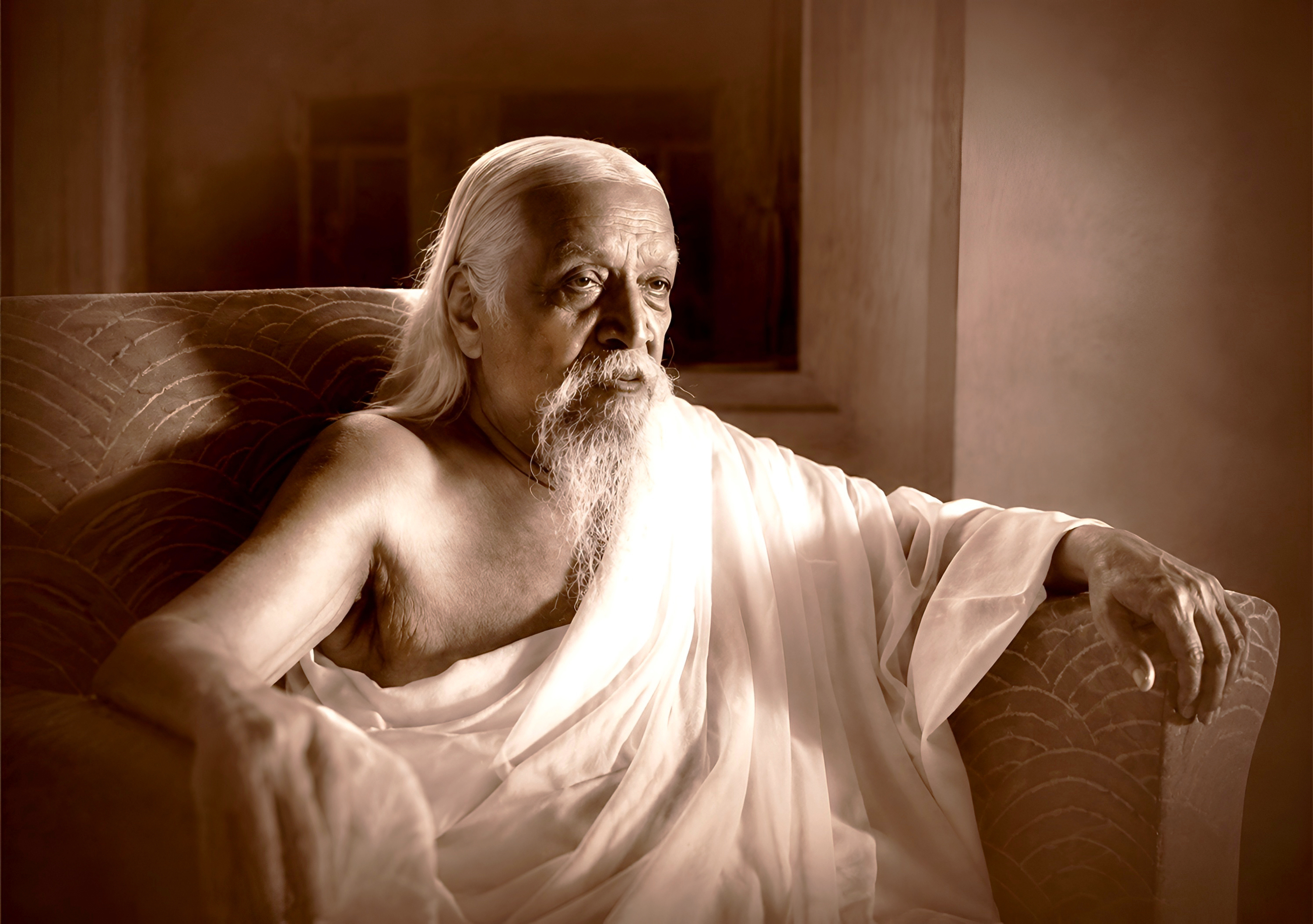
Sri Aurobindo's writing on education and on the nature of a living culture gives this institution its philosophical floor. His conviction that the past's greatness is a promise of greater ideals for the future is not a slogan here — it is the operating premise. His three principles of true teaching — that nothing can be taught, only discovered; that the mind must be consulted in its own growth; that education must move from the near to the far — form the deep structure of every program SAKS offers.
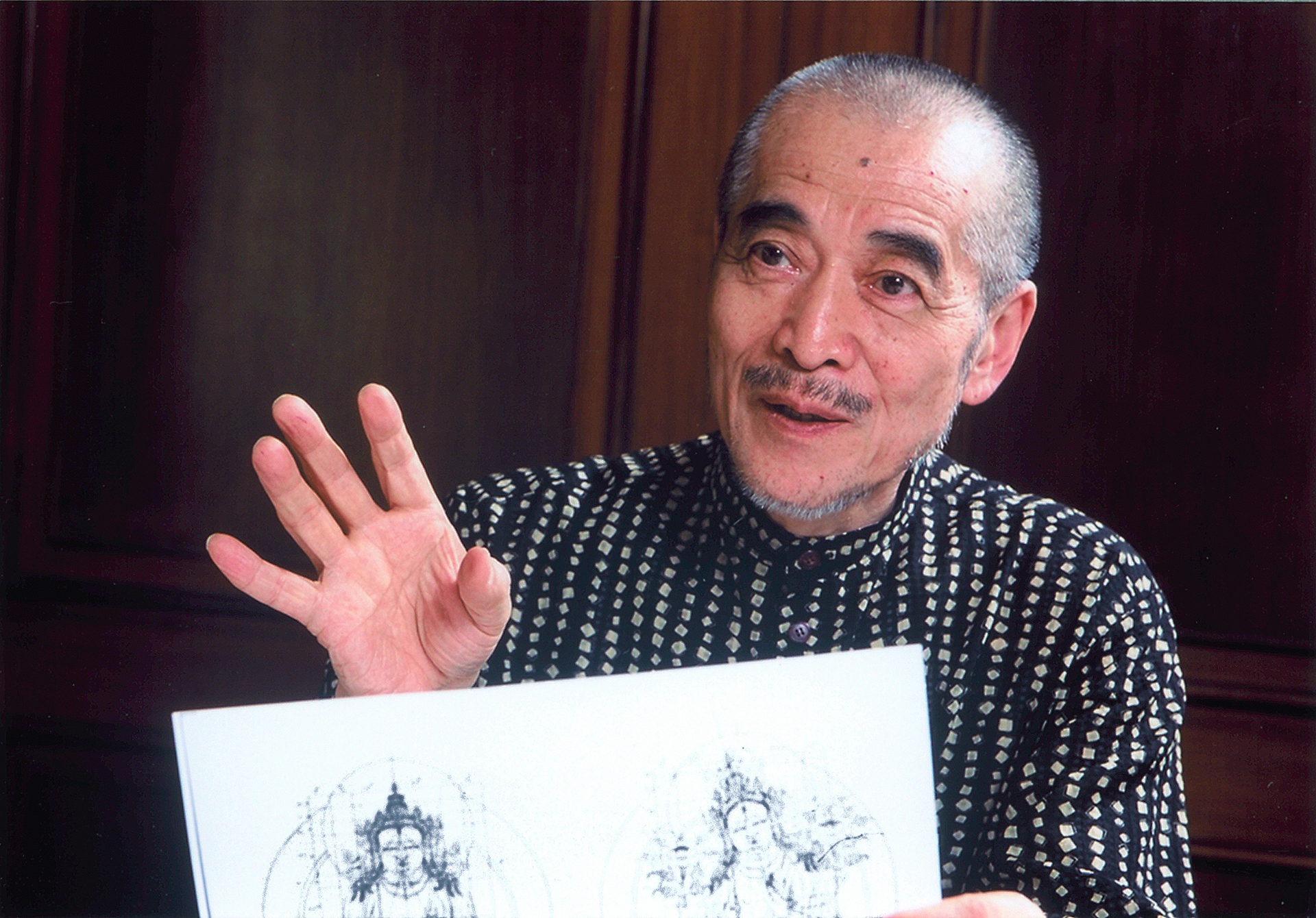
Kohei Sugiura — book designer, typographer, philosopher of Asian visual culture — spent decades building a design methodology rooted in the belief that the Asian aesthetic tradition is not a local variation of a European original, but an independent and equally rigorous visual intelligence. His six-module methodology is the backbone of SAKS's courses: taught directly from material developed by Prof Kirti Trivedi over four decades of close study, in a form that exists nowhere else in the world.
In 1981, Kirti Trivedi travelled to Japan as a UNESCO Fellow and worked under Sugiura — encountering for the first time the intellectual depth of the Asian design tradition. That encounter set the direction of nearly everything he built since: India's first Master of Design Programme in Visual Communication, four decades at IDC IIT Bombay, and now SAKS — the institutional home for the methodology he first encountered as a young Fellow, finally given the dedicated structure it deserves.
The Philosophical Ground
Written in the early twentieth century, these principles have become more urgent, not less, in the age of artificial intelligence.
The first principle: nothing can be taught. The teacher is not a supplier of knowledge but a guide and helper. Education is not a transfer from one mind to another — it is an awakening of what is already within the student. This is not a romantic idea; it is a precise description of what design education, at its best, actually does. The design teacher's job is not to show students how to design, but to help them discover their own capacity to give form to ideas.
The second principle: the mind has to be consulted in its own growth. Teaching must follow the grain of the student's own intelligence, not work against it. The right question is not what the student must learn but what the student is ready to discover. The implications for design pedagogy are significant — and are a central preoccupation of the PG Program in Design Education.
The third principle: work from the near to the far. From what already is to what shall be. Not from abstract principles to their application, but from the student's actual present condition toward the horizon of their potential. This is what makes design education different from design training — and it is what the post-AI moment demands most urgently, now that training has become the machine's territory entirely.
A culture walks forward on two legs — one planted in tradition, history, and depth of thinking. The other advancing into new practice, new media, new forms. It is the alternation between them, taken seriously, that constitutes progress.
Kohei Sugiura · The Way of Asian DesignThe Methodology
The six-module course at SAKS represents four decades of study and teaching by Prof Kirti Trivedi — the only place in the world this methodology is taught in this form.
View the courses →Sugiura's methodology begins from a challenge to the assumption that runs through most twentieth-century design education: that there is one design tradition — broadly European, broadly Bauhaus-derived — and that all other traditions are either local colour variations or lagging behind. His life's work is the counter-argument: that the Asian visual tradition — its relationship between image and text, its approach to the book as a three-dimensional object, its use of empty space not as absence but as a structural element — is an independent and equally rigorous design intelligence, from which a designer trained only in the Western canon has genuinely something to learn.
The Book as a Three-Dimensional Object. The first module begins with the most basic thing: a book is not a flat surface. It is an object in space, with a spine, a weight, a texture, a way of being held. Sugiura's own book designs — and he is one of Japan's most celebrated book designers — begin here, treating the object itself as a design problem before a single line of text is set.
One as Two, Two as One. The relationship between image and text in Asian typography is not a hierarchy — image subordinate to text, or text explaining image — but a genuine dialogue. This module works directly with that relationship, in ways that have no direct parallel in Western typographic education.
The Asian Way of Design. The fifth module widens the frame: what does it mean to design from within this tradition rather than toward it? Sugiura's own position as a Japanese designer working with Indian and Chinese visual philosophers — the dialogues that produced his published philosophy of Asian design, to which Prof Trivedi was a credited contributor — is the source material here.
The Founding Vision
Sri Aurobindo Kala Sangam exists because of a deep conviction that has been growing quietly in Indian design for years. The design community has reached a point where simply reflecting international practice no longer carries weight — it must originate its own. Not a nostalgic return via ornamentation, and not a rejection of the contemporary — but a deep understanding of the rigourousness of Indian aesthetics brought into contemporary interpretation, in response to the needs of the present day. Kohei Sugiura described it as the way a person actually walks: one leg in the ground, in history, in inheritance; the other stepping forward, into what is new. Neither alone gets you anywhere.
The relationship between Kirti Trivedi and Sugiura is not incidental to SAKS — it is its origin. In 1981, Trivedi travelled to Japan as a UNESCO Fellow and worked directly under Sugiura, encountering for the first time the intellectual depth and rigour of the Asian design tradition. That encounter set the direction of nearly everything he built since: India's first Master of Design Programme in Visual Communication, which he founded that same year; four decades of teaching at IDC, IIT Bombay; participation in 2007 at Nanyang Technological University's seminal Asian Design seminar alongside Sugiura, Ahn Sang-soo, and Lu Jingren; and his role as credited Indian contributor to Sugiura's own published philosophy of Asian graphic design.
The Sugiura courses and the Postgraduate Program at SAKS are both built entirely from Trivedi's own material — developed over decades of close study and teaching, not adapted from elsewhere. By December 2025, his teaching career had reached fifty years, marked by a retrospective exhibition in Bangalore. SAKS is not a retirement project; it is the institutional form that was always the destination of that work.
The achievements of the past were great, but the achievements of the future will be greater still. Yet even this is not all; for we must know that each new achievement builds upon and compasses all that has been already achieved. The past is our foundation, the present our material, the future our aim and summit.
Sri AurobindoWhy Puducherry
Three things make Puducherry the only possible location for an institution with this philosophical premise. The Sri Aurobindo Ashram — not a historical monument but a living practice of the integral yoga he developed here — means that the ideas SAKS takes as its foundation are not abstract references but a daily presence in the city. Auroville, twelve kilometres away, represents the most serious attempt in the twentieth century to build a creative community without the usual institutional structures — the spirit that animates the fellowship model directly. And the Bay of Bengal, at the edge of the city, gives the place a quality of openness and awe that no inland city can provide. Standing at the shore, with the horizon in front of you, things scale correctly. That matters for creative work.
About Puducherry →